Showing posts with label Theories and Philosophies. Show all posts

Wednesday, September 30, 2009

An MBA in Hustling

Given the amoral utilitarianism of Russia's oligarchs it's not surprising that they would be willing and able craft what may very well become one of the only business schools that's more than a circle jerk rest stop for burned-out bankers and bored corporate types seeking to switch careers.
Learning how to deal with the prevalent issues of politics, bureaucracy and corruption is applicable not just to emerging markets, but to the developed world as well. Wherever there are puppet politicians there are puppeteers pulling the strings.
Furthermore, anyone who has worked for a large corporation understands the importance of successfully navigating office politics and greasing bureaucracy's palm to free oneself from its suffocating grasp.
A handful of top Russian business figures have created an MBA program that tackles the issues they faced themselves: bribery, relentless bureaucracy, imperfect laws.
Skolkovo includes classroom courses in management theory, but invites dozens of guest speakers [and] might even invite an organized crime boss to talk about the challenges of management.

Skolkovo faculty members say they avoid moral judgments, and offer no ready-made strategies for handling corruption and predatory practices.

Among the patrons are some of the Russian business world's biggest names: Abramovich, the billionaire investor and owner of the Chelsea football team, donated 26 hectares (64 acres) of choice land outside Moscow for the construction of the gleaming $250 million campus, which has its own helipad.
Skolkovo's training doesn't come cheap. Fees for a full-time MBA including accommodation, flights to India, China and the U.S. come to euro50,000 ($74,000).

Thursday, September 24, 2009

Robertson puts it in real simple terms for the fools on the Hill

...but somehow I doubt even these clear and irrefutable facts from one of the brightest minds in finance will make them listen.
When all you're thinking about is reelection, or your immediate problems - in the case of dimwitted constituents, it's hard to see past to the burgeoning debt load that will put a vice grip on future generations. At least we'll all be green - cars will be too expensive and dollars will be crowding out all other colors in landfills.
clipped from www.cnbc.com
The US is too dependent on Japan and China buying up the country's debt and could face severe economic problems if that stops, Tiger Management founder and chairman Julian Robertson told CNBC.
Julian Robertson
"It's almost Armageddon ... if the Chinese and Japanese stop buying our bonds, we could easily see [inflation] go to 15 to 20 percent.
It's not a question of the economy. It's a question of who will lend us the money if they don't. Imagine us getting ourselves in a situation where we're totally dependent on those two countries. It's crazy.”
“The other thing is, they're buying almost exclusively short-term debt. And that's what we are offering, because we can't sell the long-term debt. And you know, the history has been that people who borrow short term really get burned.”
"The U.S. has to quit spending, cut back, start saving, and scale backward," Robertson said. “I really do think the recession is at least temporarily over. But we haven't addressed so many of our problems and we are borrowing so much money that we can't possibly pay it back, unless the Chinese and Japanese buy our bonds.”

Wednesday, August 05, 2009

White House wants to bring out the Pavlik Morozov in all Americans

I am sure this name Pavel Morozov is foreign to Americans. In a nutshell, he was a darling young boy who achieved martyrdom in Soviet Russia by reporting his father's un-Partylike activities to the police. The father was summarily arrested and executed, and Pavlik's family, unable to see his unbridled patriotism, murdered him. There are statues of Pavlik throughout Russia, and schoolchildren were indoctrinated taught about his courage and bravery.
The Administration hopes that Joey Sixpack will take Morozov's fallen torch by sending in "fishy" emails about the President's Master Plan to the authorities at the White House. Can you imagine the [completely justified] outcry had Bush enacted such a policy?
I am sure that this story will be generally dismissed by the media and quickly die down in popularity (maybe the President can stage a bourbon summit as a distraction this time?), but the fact remains that fundamental principles on which this country was founded upon are being ever so slightly encroached.
Put a frog in boiling water and it'll jump out, but turn the heat up slowly and it will never realize that it's being boiled alive.
clipped from www.whitehouse.gov

Opponents of health insurance reform may find the truth a little inconvenient, but as our second president famously said, "facts are stubborn things."

Scary chain emails and videos are starting to percolate on the internet, breathlessly claiming, for example, to "uncover" the truth about the President’s health insurance reform positions.

There is a lot of disinformation about health insurance reform out there, spanning from control of personal finances to end of life care. These rumors often travel just below the surface via chain emails or through casual conversation. Since we can’t keep track of all of them here at the White House, we’re asking for your help. If you get an email or see something on the web about health insurance reform that seems fishy, send it to flag@whitehouse.gov.

Tuesday, July 21, 2009

Let's drop the pretense and the trousers.

Apparently the firms that were able to quickly repay the TARP money, with 23% interest to the taxpayers, and immediately turn a profit are not to be praised. Indeed, they are villains of the highest order. Their crime is that they dared to succeed without the government's help and oversight. In fact, those unbridled rapscallions couldn't wait to shake Geithner off the saddle and spit Obama's bit from their foaming mouths.
Naturally, Obama is upset that there's an important sector of the economy he doesn't have full control over - so it's important we quickly pass reform to nationalize everyone, regardless of their financial condition. At least he's finally being forthright about his intentions.
clipped from www.pbs.org
JIM LEHRER: Speaking of the economy, do you share the concern and growing anger by some people over the fact that these big Wall Street banks are suddenly making these huge profits while the unemployment rate continues to go up, foreclosures continue to rise, all kinds of other bad things are happening to individual Americans on the economy.
PRESIDENT OBAMA: The problem that I've seen ... is you don't get a sense that folks on Wall Street feel any remorse for having taken all these risks; you don't get a sense that there's been a change of culture and behavior as a consequence of what has happened.
Now, there are some companies, like Goldman Sachs, that have paid the money back and that means that we don't have the same kind of levers on them that we might have. And that's why I think it's important to pass this broader financial regulatory reform package.
Make no bones about it, I am pushing hard.
President Barack Obama

P.S. If you don't want firms to take irresponsible risks, then maybe you shouldn't let lobbyists tattoo "2Big2Fail" on the back of every lawmaker's skull.

Friday, June 12, 2009

Soros confuses CDS for Puts

The apparently attrocious payout scheme of a CDS that Soros illustrates is remarkably similar to (as in exactly the same as) that of a vanilla Put option. Should those be outlawed as well?
There is no doubt option volume has a "reflexive" effect on the underlying stocks as well. The reason for this, however (and Soros even points this out himself), is because dumb money eventually follows smart money and smart money likes smart instruments (derivatives) that they can tailor precisely to their views on any particular aspect of a firm. The fact that professionals are expressing their views (in CDS' case on "adverse developments" affecting an issuers' credit rating) only leads to greater market efficiency and quicker fair price discovery.
Companies don't fail because evil speculators shorted/wrote puts on their stock or bought protection on their bonds. They fail because their management fucked up.
clipped from www.guardian.co.uk
"CDS are instruments of destruction which ought to be outlawed," Soros told a meeting of the Institute of International Finance.
Going short on bonds by purchasing a CDS contract carried limited risk but almost unlimited profit potential. By contrast, selling CDSs offered limited profit and practically unlimited risk, Soros said.
Soros said: "People buy a CDS not because they expect an eventual default but because they expect them to appreciate in response to adverse developments."
"It's like buying life insurance on someone else's life and owning a license to kill," he concluded.
He said derivatives should be standardised and saw no case for custom-made derivatives, which he said only increased the profit margins of the financiers who tailored them.
Soros' criticism echoes fellow investor Warren Buffet's description of derivatives in 2003 as "financial weapons of mass destruction".

Wednesday, March 25, 2009

Jake DeSantis is a Real American

We need more people like Jake right now. He's not a hero, but true American in the classical Federalist sense. These are people who aren’t afraid to look tyranny right in the face and say “Don’t Tread On Me”.

When a government is using outright extortion to get money from its citizens, when banks are forced to accept unwanted capital that comes with retroactive strings manned by a maniacal puppeteer, when debate is condemned by the White House, when succeeding in the American Dream becomes a crime, when the constitution is spat on by every half-wit in Washington - that is when we need to look back upon our Founding Fathers for guidance and resist oppression.

"Government is not reason; it is not eloquent; it is force. Like fire, it is a dangerous servant and a fearful master." - George Washington

Please read the entire letter here.
clipped from www.nytimes.com
The following is a letter sent on Tuesday by Jake DeSantis, an executive vice president of the American International Group’s financial products unit, to Edward M. Liddy, the chief executive of A.I.G.
I am proud of everything I have done for the commodity and equity divisions of A.I.G.-F.P. I was in no way involved in — or responsible for — the credit default swap transactions that have hamstrung A.I.G.
Most of those responsible have left the company and have conspicuously escaped the public outrage.

After 12 months of hard work dismantling the company — during which A.I.G. reassured us many times we would be rewarded in March 2009 — we in the financial products unit have been betrayed by A.I.G. and are being unfairly persecuted by elected officials. In response to this, I will now leave the company and donate my entire post-tax retention payment to those suffering from the global economic downturn. My intent is to keep none of the money myself.

Friday, March 06, 2009

Scholes' other BS model

Old man Scholes wants to "blow up" the entire $531 trillion derivative market as a way to "prevent crisis". While I'm all for market-to-market over mark-to-model this plan is like curing a brain tumor by shooting yourself in the head. It would cause a complete collapse of the global economy. Of course this plan is just crazy enough for Washington to consider it. Oh, and that pricing model you spent years developing to capture arbitrage, yeah well we're nationalizing that bad boy too.
clipped from www.bloomberg.com
Myron Scholes, the Nobel prize-
winning economist who helped invent a model for pricing options,
said regulators need to “blow up or burn” over-the-counter
derivative trading markets to help solve the financial crisis.
The “solution is really to blow up or burn the OTC market,
the CDSs and swaps and structured products,
“One way to
do that, through the auspices of regulators or the banking
commissioners, is to try to close all contracts at mid-market
prices.”
“Take the pricing mechanism from the desks in banks, which
have made a huge amount of profits over the last number of
years, and facilitate price discovery,” Scholes said.
A total of $531 trillion in outstanding derivatives
contracts traded over-the-counter as of June.
Scholes was a partner in Long-Term Capital Management LP,
the hedge fund whose $4 billion loss in 1998 set off a near-
panic in financial markets and prompted the Federal Reserve to
orchestrate a bailout by 14 lenders.

Tuesday, December 04, 2007

Greene on the New Princes

My friend sent me this article today by the very lucid Robert Greene writing on Machiavelli (as he often does for a living) in the 21st century. I had to add my own two cents. I highly suggest you read the article first, and then my opinions on it.
Necessity governs the world.
When you feel necessity biting at your heels, you are moved to respond in some way that is creative. It is either that or die.
I must constantly create challenges for myself, find some way of feeling limited and pressured, never resting on what I have done in the past.
Fortune rewards those who are bold; she is a woman.
When I enter a negotiating situation, I always make sure I feel that I can walk away from an offer.
Some want to rule, others to be ruled.
In Machiavelli's world, people are not victims. Those who suffer under some form of tyranny inevitably have gotten the kind of government they want or deserve. They are unconsciously implicated in the process. No one, in Machiavelli's universe is some passive actor who is acted upon and injured.
Greene elaborates on a principle in his first section that I find absolutely critical in gaining, maintaining and expanding personal success – never feel complacent. If no outward challenges exist then create new ones to maintain your drive. To use the metaphor of a businessman as a shark – if you stop moving forward you die, thus one must find reasons to keep going. The fact that this lucid comparison has such negative connotation in our present society – where children are encouraged to rest on their insignificant laurels, where everyone is “special”, where capitalism is equated to fascism by the ignorant masses, speaks volumes to its laggard nature.

Greene’s discourse on boldness is also poignant, though this negotiating strategy is not novel. In displaying the will to walk away from a deal, a job, a trade, etc. you flex power over whoever sits in front of you. Of course should you find yourself facing another strong-willed individual on the other side of the table he may find this display arrogant, or worse – imminently dangerous to his position and thus seek to undercut you. Having a superior of weaker will than you is thus often useful, so long as you can stay self-motivated.

So far as peasants preferring to be ruled, that’s a sure fact that I’ve observed in depth while growing up in Russia. If more Americans understood this they would be able to see how Putin can govern Russia with a diamond-studded iron fist and still have tremendous support of the people. Ironically, our current complacent culture in America feels that it cannot allow itself to be lead and is thus causing itself tremendous pain and distress – but unwilling to chastise itself
rather than its inept leaders and cause change the only way it can occur – through action and pragmatic self-betterment.

Tuesday, August 21, 2007

The Value of Money

Had a discussion with some intellectual friends today about the joys and burdens of money, and how as it relates to a fulfilling life of happiness, and whether the latter can be achieved with the former if one makes its acquisition his central pursuit. Here is a summary of my thoughts on the matter for all those curious:
  1. Your family and genuine relationships (that is, those which would withstand any material stress test) matter the most in life no matter who you are or what's in your wallet.
  2. “Friends” who hang around you because of your socioeconomic status are leeches and should be treated as such - in the medical sense - that is, you should only allow them close to you if they serve a purpose and then immediately discard them.
  3. Money is an enabler of greater enjoyment of our immaterial possessions. It is perfectly rational to live in the moment instead of only being focused on working to make your "tomorrow" better since that day, as my friend pointed out, will never come if you set no clear goals and become caught up in a neverending race to acquire ever greater wealth. What if living in the moment, however, involves chartering a jet to Paris for a weekend with the woman you love? What if it involves buying a work of art you’ve always admired or populating your library with first editions? Do you need these things to be happy? Of course not. All man needs (loosely based on Maslow's Hierarchy) is physical nourishment, intellectual stimulation and love.
  4. Thus I agree that it is worthless to chase money aimlessly (and especially if you must sacrifice your relationships, your youth or your health) but if you truly love what you do and by luck it happens that this profession makes money then you shouldn’t feel like your life lacks meaning just because you’re not engaged in what society deems to be more creative or nobler pursuits. A person who derives his greatest joy from structuring derivatives should not try to be a poet, painter or doctor. Doing what's against your nature is never right.
  5. A litmus test I often ask myself is "Would I still do this job for free and if I just won the lottery?"
  6. I’ve often wondered myself what other careers I could’ve pursued, but the reality is we have many talents and you won’t be able to explore and grow them all fully. Thus you have to compromise and pick your path, and in doing so choose the one that you will enjoy the most, not the one that will lead you to the greatest riches, fame or power. I don’t know many people who achieved greatness in finance or otherwise who did not love what they did. You need passion to excel.

Friday, May 11, 2007

Eat the Rich!

EquityPrivate has a superb post that, with great wit, highlights the fallacies and sheer irrationality of those who consider it damn near [if not outright] criminal that Private Equity firms and its partners don't pay full income tax on their fees. About the only thing she didn't touch on is a jab at the Islamic Banks. Actually if she would do a post on a Private Equity firm/Risk Arb hedge fund that abides by Shariah I just might cry.
I highly recommend that you read the whole post and not just my clip, even if you're a pinko tree hugger. Of course true liberals will have no choice but to consider EquityPrivate's Swift-esque proposals as potentially good policy in their Utopian society where imprisoning free markets results in economic prosperity and world peace.
Let us instead consider the many ways that people earn money with "other people's money." Obviously, all of these should be closed as "loopholes."

Housing Loans

I mean really. A home owner puts down a paltry 20% of the purchase price, borrows the rest from big and stupid banks that don't know they are being taken advantage of and then pockets the gain for themselves.

Car Loans

This is exactly the same thing.

Anything this car trades for or sells for over the Blue Book value should be taxed at double ordinary income rates.
Margin Purchases of Stock
I don't care if you held that stock for 4 years and paid margin on it the entire time. This should be taxed at ordinary income rates. We'd hate to encourage participation in the capital markets, after all.
Employee Stock Options Plans
why are we letting the company get away with promising stock that hasn't been paid for yet anyhow? That looks like a loan. This needs to be taxed.
Any true, red-blooded American firm should work hard to maximize taxes.

Monday, May 07, 2007

Greed Is Back! (and still Great)

One of Hollywood’s most lovable characters (from his starched collar down to his polished wingtips) will return for a Second Coming to save America, and as hedgie to boot!
Since the writers will obviously need some ideas, I’ve drawn up a few suitable strategies for Gekko’s fund:
  • Gekko buys Iran CDS, and then lobbies the President to bomb the shit out that hole (bonus for crude leverage).
  • Quietly acquires Russia’s grain and potato fields, then convinces the now vodka-less populace to give him Gazprom and makes Putin and Abramovich fight a tag team grudge match against Berezovsky and Khodorkovsky in a polonium plated cage.
  • Buys out a Texas utility promising to replace all the dirty coal plants with those that run on rainbows and unicorn farts. After the deal is closed Gecko doubles coal production. I know it’s wishful thinking, Henry, but this is supposed to be an uplifting movie.
  • Reemerges as an avid environmentalist and sets up a SRI (Socially Responsible Investment) fund that acquires stakes in companies that produce affordable American made hybrids (made by illegal immigrants for 50 cents an hour), biodiesel (with sugarcane harvested by 7 year old Brazilian slaves after they mow down enough rainforests to make room for the fields) and organic meats (from “rescued” animals).
I’m expecting full royalty payments.
clipped from www.nytimes.com
as their boss, Rupert Murdoch, pursued an uninvited takeover bid for Dow Jones this week, Fox movie executives quietly sealed a deal to revive Gordon Gekko
When last seen, the corrupt Gekko, an Oscar-winning role for Michael Douglas, was on the brink of surrendering his white cuffs for handcuffs, having been sold out by his protégé Bud Fox
“He went to jail,” acknowledged Edward R. Pressman, who produced the original movie and reached an agreement with Fox this week to develop a sequel in which Mr. Douglas will resume his machinations on a global scale in the hedge-fund era.
the title, he said, will be “Money Never Sleeps,”
a restyled Gekko, he predicted, might start setting trends all over again.
“If you weren’t wearing suspenders before ‘Wall Street,’ you were certainly wearing them after,”
Speaking by telephone from Bermuda, Mr. Douglas said he wouldn’t mind if he never had “one more drunken Wall Street broker come up to me and say, ‘You’re the man!’ ”
Mr. Stone will not direct the sequel

Thursday, March 29, 2007

Worse than Welfare

On one hand I do think a program like this has a chance to accomplish its mission, if executed correctly, and with private funds that’s all gravy - as good a charity as any. Unfortunately the article says that "If the experiment is successful, officials plan to make it a government-financed program." But why the hell should I give money to the poor for doing something that directly and immediately benefits them? Why the hell should I pay some random person because they went to the doctor when they were sick? Bloomberg compares this extortionist program to performance related bonuses on the job, which you get because you helped the firm make more money than it could have without you. The company is simply giving you a piece of the pie you helped bake. I really don’t see how some chump holding down a job at Mickey D’s for a year is going to translate into a return on my investment.
clipped from www.nytimes.com

Seeking new solutions to New York’s vexingly high poverty rates, the city is moving ahead with a bold antipoverty experiment that will pay poor families up to $5,000 a year to meet targets like exemplary school attendance, going for medical checkups or holding down a full-time job, Mayor Michael R. Bloomberg said today.

The incentives, he said, would allow struggling families who are often focused on basic daily survival to make better long-term decisions.

“In the private sector, financial incentives encourage actions that are good for the company: working harder, hitting sales targets or landing more clients,” Mr. Bloomberg said in making the announcement at a family services center in Brownsville, Brooklyn. “In the public sector, we believe that financial incentives will encourage actions that are good for the city and its families: higher attendance in schools, more parental involvement in education and better career skills.”

powered by clipmarksblog it

Wednesday, February 21, 2007

Hedging Morals

If you know me, you know I’m not big on Kantian ethics and morals. Nevertheless I found myself in the middle of an ethical conundrum today. If I believe that the new Hamas-Fatah alliance and trouble in Iran will result in greater perceived risk for Israel then it makes sense that I short the Shekel and sell Israeli government bonds. The dilemma arises in that once I own the position I make money if Israel gets bombed, something that I definitely don’t want to see happen as a Jew with many relatives living there. My moral and monetary incentives are instantly misaligned.

The same is never the case when shorting US Treasuries or dollars – after all with that I’m betting on Bernanke’s babble, not another 9/11 which would have pronounced effects on all global markets - unlike Israel which is too small to affect many countries outside of its region.

In any case I put on the trade. I don't believe that Israel is in a good place right now, and even though I pray that nothing happens I know that's damn unlikely. With Israeli CDS spreads being as tight as they are now any serious militant attack is going to widen them considerably. One could say that the trade is like a call option on my morals (if something bad does happen, at least I'll make money) but I'm not going to go down that path. The bottom line is that when trading, especially with other people's money, you have to put your own (non-collective) morals and individual incentives aside so that you can execute the best possible strategy.

Tuesday, February 13, 2007

Things are getting interesting...

…might be time to make a move. Long LNG.

Qatar Shows Interest In Natural-Gas Cartel
By JAMES HERRON, WALL STREET JOURNAL
February 13, 2007; Page A2

Qatar's interest in exploring the creation of an OPEC-like cartel for natural gas adds another major producer to a group that includes Russia and Iran. Even so, industry experts say the nascent effort faces significant obstacles, ranging from a fragmented market to a history of noncooperation among the world's biggest holders of reserves.

Russian President Vladimir Putin and Qatari Emir Sheik Hamad bin Khalifa Al Thani said yesterday, at a meeting in Doha, Qatar, that they wanted competing gas producers to cooperate more. Mr. Putin said he would send a team of experts to a natural-gas conference in Doha in April, where they would discuss details of building a cartel. (Putin is serious – he wants to control the world through power and is feeling unstoppable, which is why he feels freedom now to make open anti-American comments. Such words precede actions. Putin is on a Middle East tour for more than one reason.)

The leaders of Russia, the No. 1 gas producer in terms of reserves, and No. 2 Iran have been talking recently about creating a group similar to the Organization of Petroleum Exporting Countries, which manages its output in an effort to sway crude-oil prices world-wide. If such a group were formed, the inclusion of No. 3 Qatar -- a major producer of liquefied natural gas, or LNG -- would give it significant clout. (and the rest of the dominoes fall into place)

But forming such a group could be difficult. Sheik Hamad said he supported the discussions, but he was unsure whether a gas cartel would be able to command the same degree of market control as OPEC does.

Gas demand is climbing amid global economic growth and because it burns cleaner than other fuels. But gas markets are fragmented, in part because transporting gas overseas can be difficult, complicating efforts to form a single global market, like oil, in which a group of producers could hold sway. LNG, which is natural gas cooled into liquid form and shipped overseas via tanker, has moved natural gas closer to a world market, but it remains a small part of global use. (Except Russia has plenty of tankers ready to go and more being built).

Also, gas tends to be sold through long-term contracts. That means a cartel would have little influence on such arrangements, Sheik Hamad said in a press conference in his presidential palace.

Past efforts haven't led to significant cooperation among gas producers. Russia, Qatar and Iran are members of the Gas Exporting Countries Forum, which was formed in 2001 but hasn't met since 2005.

Jonathan Stern, Director of Gas at the Oxford Institute For Energy Studies, said Mr. Putin's talk of closer cooperation among gas exporters isn't the same as a cartel and "doesn't mean a price-setting or volume-setting organization." He said Russia and Qatar, as gas exporters, don't have much in common, and they have much more potential to be competitors, especially in the European market. (Putin can be a very persuasive person in dissuading competition and is more than willing to give generous incentives).

A spokeswoman for the International Energy Agency said a cartel that raises prices "will encourage consumers to reduce demand or switch to other fuels. This is particularly true for gas, which can be substituted with coal and nuclear." (Except coal is under attack in the US and nuclear has tremendous fixed costs, and impossible for developing countries that can still afford Gas/LNG).

Julie Reside, a State Department spokeswoman, said there has been talk of a possible "gas OPEC" for many years, with no result. "I think experience has shown that free and open markets work best for both producers and consumers," she said.

Russia has sparked concern in the West that it is using its vast energy reserves as political leverage. (No Shit) Mr. Putin has dismissed the criticism, and he has defended moves to raise gas prices on some customers as an effort to put market prices in place after years of lower prices. (That's why he's been doing it now and all at once, knowing full well that it would be ill received, instead of instituting gradual programs years ago).

Putin has a master plan. Russia will be getting very interesting this year leading up to the elections and beyond. Stay on the sidelines or get in the game, either way there will be fireworks and money to be made.

Monday, February 05, 2007

The New Gulags

A Forbes article on Khodorkovsky's Suffering

In many other countries Khodorkovsky would be seen as an unyielding martyr against the totalitarian establishment, or at least a figure worthy of sympathy – but in Russia the majority blindly support Putin and want his enemies squelched. The fun will really start this November as Russian “elections” get underway. The average Russian peasant does not want to worry about politics or the outside world – they would much rather submit completely to a strong authoritarian leader. The only reason that the Soviet revolution happened is because Czar Nicolai was incompetent and of insufficient character to rule with the requisite force. This is the most crucial ironclad fact of Russia – yet so many people continue to forget it or choose to ignore it, and always at a hefty price. Another example of someone who thought he could “save” the Russians is the American idiot from Forbes who got shot – while walking to the metro at night without bodyguards, but that’s another story.

Friday, November 17, 2006

Crapocalypse Now Redux

Check out this NYT article on G-Dub in Hanoi:

Mr. Bush spoke of driving by the lake where Senator John McCain’s plane crashed nearly 40 years ago, focusing less on Mr. McCain’s long imprisonment afterward than on the fact that “he was, literally, saved, in one way, by the people pulling him out.”
Thank you so fucking much for “saving” Senator McCain, and by saving I mean:

On October 26, 1967, McCain's A-4 Skyhawk was shot down by an anti-aircraft missile, landing in Truc Bach Lake. He broke both arms and a leg after ejecting from his plane. After he regained consciousness, a mob gathered around him and stripped him of his clothing. He was then tortured by Vietnamese soldiers, who bayonetted him in his left foot and groin. His shoulder was crushed by a rifle butt. He was then transported to the Hoa Lo Prison, also known as the Hanoi Hilton. Once McCain arrived at the Hanoi Hilton, he was placed in a cell and interrogated daily. When McCain refused to provide any information to his captors, he was beaten until he lost consciousness. Alexander, Paul (2002). John McCain: Man of the People
McCain, who unlike Bush, was an actual combat pilot and a damn good one at that, withstood torture upon torture in the name of his country, yet Bush is willing to dismiss all that by calling his captors saviors. I cannot even begin to tell you how disgusted I am by that.

The story continues, however:

For Mr. Bush, who had never set foot in Vietam before, this visit is something of a tightrope walk. America’s defeat here is increasingly being mentioned in comparison with how Iraq may turn out, and Mr. Bush was careful to stress that in Iraq, unlike Vietnam, defeat is not an option for the United States.

Yes – clearly defeat was an obvious option in Vietnam from the start. That is exactly what the administration said throughout that conflict. Oh wait, no – we lost sixty thousand soldiers believing in our just and infallible cause to democratize and liberate a foreign nation, and then eventually realized this may not have been such a hot idea. Whoops. Can we at least say we’re fighting for Oil or something else worth dying for? The people need a real material cause.

I also like the statement that Stanley Kranow makes in the end:

The easy summation is that Vietnam began as a guerrilla war and escalated into an orthodox war — by the end we were fighting in big units. Iraq starts as a conventional war, and has degenerated into a guerrilla war. It has gone in an opposite direction. And it’s much more difficult to deal with.

We “won” the war in a matter of weeks. It was our incessant need to promote democracy and autonomy of the indigenous people rather than imposing strict martial law and a puppet dictator with an army of primarily local soldiers (and I hope by now the US has learned how to properly keep one restrained) that kept us there, suffering casualties as we try to gently pacify people who never wanted us there in the first place. Whichever party you affiliate with (although perhaps especially for us Libertarians) it's getting ever easier to lose faith in the government.

Wednesday, November 15, 2006

Who will Gazprom assasinate next?

After this cheeky bit of news:

“The head of a Russian fund that says it promotes the development of small oil
and gas producers was shot dead on Tuesday in southwest Moscow, the Reuters news agency reports. Zelimkhan Magomedov, 50, general director of the National Oil Institute Fund, was shot twice in the head.”
One simply has to wonder - who will be next? Will it be…

Arkady Ostorvsky for making the below comment in his article in the WSJ:
"Gazprom, the dominant gas supplier that frequently doubles as a Kremlin foreign policy arm, is not producing enough for an economy growing at more than 6 per cent a year. "

Vladimir Milov, head of the Institute for Energy Policy, for making the following comment to the media:
"Gazprom was given enormous privileges in exchange for providing the country with gas at regulated prices. If it wants to behave as a commercial company, it should not be a monopoly."

German Gref, minister for economic development and trade for implying Gazprom should be “independently regulated.”

Analysts at UBS Russia for questioning Gazprom’s strategy.

“Analysts say the problem is not the lack of gas - Russia has 16 per cent of the world's total reserves - but rather Gazprom's investment strategy. Over the past few years the company has spent vigorously on anything but developing its reserves. It has built a pipeline to Turkey, taken over an oil company, invested in UES and tried to gain a foothold in European distribution markets. All this was in the name of creating a national energy champion. But investment in Gazprom's core activity was inadequate.”
Why has Gazprom not been investing in developing fields? Because it’s going to take Sakhalin away from Shell (who has already done all the work).

The citizens of St. Petersburg as they re-experience the horrors of WWII when their city loses heat in the middle of winter.

The country of Turkmenistan for not supplying enough gas and quibbling with the Allmighty.

Chechnyan Warlords (or random Georgians who will be dressed up to look like Chechnyan warlords) who will then be blamed for the gas shortage as well as every other problem plaguing Russia at the moment.

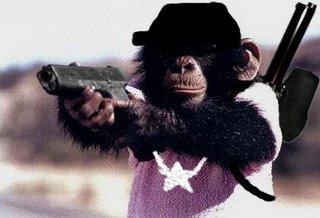
Always seeking to profit from energy arbitrage, I am relocating some of my freelance monkey snipers (alluded to in the previous post) to Russia.

Monday, November 13, 2006

cliquer l'hypothèse efficace du marché

To continue in the vein of my previous post on EMH, here’s an excerpt from a book[1] I’m reading on volatility trading:
“Those sellers using local volatility models will certainly value a digital cliquet[2] at a lower price than sellers using stochastic volatility. Perversely then, those sellers using an inadequate model will almost certainly win the deal and end up short a portfolio of misvalued forward-starting digital options, or even worse - a dealer could have an appropriate valuation approach but be pushed internally by the salespeople to match (mistaken) competitors' lower prices."
Basically – when you’re trading really complex structured derivatives nobody knows what the real price is, because said price can only be derived by a model and the models are largely proprietary. It’s arbitrary arbitrage! Without set market prices there can be no market efficiency.
Oh, but these are OTC derivatives Fama would say. To which I will reply that 1. you, kind sir, have already implied that there should be no measurable difference in efficiency when liquidity is decreased and 2. said derivatives are based on a very liquid equity option that is itself a derivation of allegedly perfectly efficient securities like equities, bonds and even currencies. Moreover, the mere fact that you cannot price these instruments without making predictions (discrete or not) about their future value means that option markets cannot be played passively on assumption that they are efficient.
At this point Fama would rise from his armchair and, thrusting his cigar at me in a decidedly confrontational manner while swirling his brandy irately, exclaim: “So am I to understand then, that you have no faith at all? No belief in market efficiency? Then I put it to you, sir, that you are a heretic of the first degree!”
To this I shall reply, while serenely sipping my single malt, “No, my friend – I am a heretic of the second degree. A heretic derivative, if you will, which is to say a rebel against theory, fighting in the name of reality. Indeed, just as you don’t advocate strong-form efficiency I in no way support the weak-form hypothesis. Moreover, I believe that news is priced very quickly (though not instantaneously) and that many (though not all) markets are mean-reverting. Nevertheless, inefficiencies exist and increase proportionately with a decrease in liquidity and regulation or an increase in complexity. Both technical and fundamental analysis can yield superior returns in the hands of a gifted (and not just lucky) individual. Some of us aren’t monkeys throwing darts at a list of stocks as your friend Malkiel believes. Rather, we are monkeys with sniper rifles. And we’ve got efficient markets in our sights.”
I then tip my hat to the bewildered Fama and make my exit. As Fama takes a sip of his brandy he realizes that ashes from his cigar have inadvertently fallen into the snifter. The taste is almost as raw as the state of his prized theory.

[1] The Volatility Surface: A Practitioner's Guide (Gatheral, 2006)
[2] From AMEX Dictionary of Financial Terms: The French like the sound of “cliquet,” and seem prepared to apply the term to any remotely appropriate option structure. (1) Originally a periodic reset option with multiple payouts or a ratchet option (from vilbrequin à cliquet—ratchet brace). Also called Ratchet Option. See Multiperiod Strike Reset Option (MSRO), Stock Market Annual Reset Term (SMART) Note. See also Coupon-Indexed Note. (2) See Ladder Option or Note (diagram). Also called Lock-Step Option. See also Stock Upside Note Security (SUNS). (3) Less commonly, a rolling spread with strike price resets, usually at regular intervals. (4) An exploding or knockout option such as CAPS (from cliqueter—to knock)
Now that your are completely and utterly bewildered stare into this headlight young deer:

Ah, now it makes sense! It’s just a performance-linked digital option with resets! Duh.